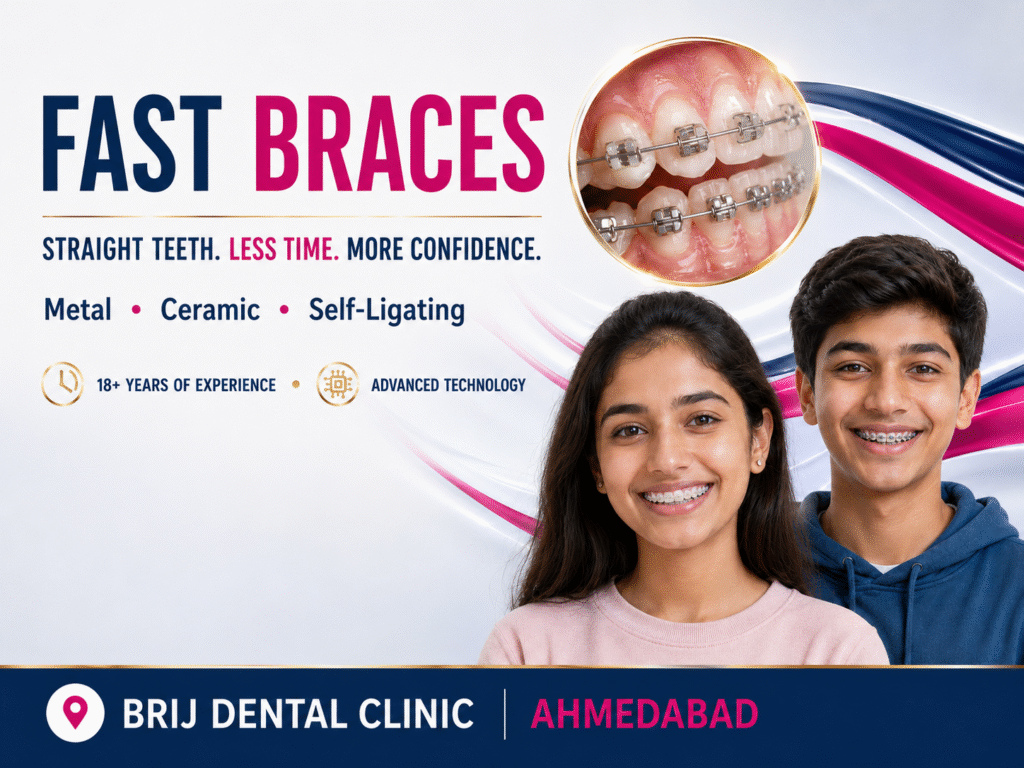
BRACES TREATMENT IN AHMEDABAD INDIA WITH BEST ORTHODONTIST AT BRIJ DENTAL CLINIC

Braces in Ahmedabad – Advanced Orthodontic Treatment for Children, Teens & Adults

Achieve a healthier, well-aligned smile with personalized braces treatment in Ahmedabad at Brij Dental Clinic & Implant Center, Naranpura. Team of best orthodontist in ahmedabad and Led by Dr. Brijesh S Patel, MDS (Guj Uni First), our dental clinic provides orthodontic evaluation and customized teeth alignment solutions for children, teenagers, and adults.

With more than 18 years of dental experience and modern diagnostic and treatment technology, we focus on planning orthodontic treatment according to each patient’s dental alignment, bite, aesthetic expectations, and oral health requirements.

Whether you are looking for metal braces, ceramic braces, self-ligating braces, or clear aligners, our team will help you understand suitable treatment options and their expected benefits, limitations, duration, and cost.

Book your orthodontic consultation in Ahmedabad to explore the right solution for your smile.

What Is Orthodontic Braces Treatment?

Orthodontics is a specialized branch of dentistry that focuses on the alignment of teeth, the relationship between the upper and lower jaws, and bite correction.

Dental braces use brackets, wires, and other orthodontic components to apply controlled forces that gradually move teeth into planned positions. Orthodontic treatment can help improve tooth alignment, bite function, oral hygiene access, and smile appearance.

Braces treatment is suitable for many children, teenagers, and adults. The appropriate treatment approach depends on factors such as tooth position, jaw development, bone and gum health, the severity of the bite problem, and the patient’s individual needs.

At Brij Dental Clinic & Implant Center in Naranpura, Ahmedabad, treatment is planned following a clinical assessment and appropriate diagnostic records.

best braces with fast orthodontic treatment in ahmedabad

What Are Some Signs That Braces May Be Needed?

Orthodontic assessment may be helpful if you notice any of the following dental or bite-related concerns:

  • Crowded or overlapping teeth.
  • Gaps or spaces between teeth.
  • Upper front teeth that protrude excessively.
  • Deep bite, where the upper front teeth cover too much of the lower teeth.
  • Underbite, where the lower front teeth extend beyond the upper front teeth.
  • Open bite, where certain upper and lower teeth do not meet when biting.
  • Upper and lower dental midlines that do not align.
  • Difficulty chewing or biting certain foods.
  • Teeth that wear unevenly.
  • The lower jaw shifting to one side during biting.
  • Persistent thumb-sucking or other oral habits that may affect dental development.
  • Teeth that are difficult to clean because of crowding or misalignment.

Not every dental irregularity requires braces. A professional orthodontic evaluation helps determine whether treatment is appropriate and which options may be considered.

Types of Braces and Orthodontic Treatment in Ahmedabad

At Brij Dental Clinic & Implant Center, orthodontic treatment options can be considered according to individual dental requirements, treatment goals, and clinical suitability.

1. Traditional Metal Braces

Traditional metal braces use brackets and archwires to gradually align teeth and correct selected bite problems.

Potential benefits:

  • Established orthodontic treatment method.
  • Suitable for many types of tooth alignment problems.
  • Available in different bracket and wire systems.
  • Often considered for cases requiring detailed tooth movement.

Metal braces may be suitable for children, teenagers, and adults, depending on their orthodontic needs.

2. Ceramic Braces

Ceramic braces use tooth-coloured or relatively discreet brackets designed to reduce the visible appearance of orthodontic appliances.

Potential benefits:

  • Less noticeable than many traditional metal brackets.
  • May be preferred by teenagers and adults who are concerned about appearance.
  • Can be considered for selected orthodontic treatment plans.

Ceramic brackets have specific strength and care considerations. Your orthodontist can explain whether they are suitable for your case.

3. Self-Ligating Braces

Self-ligating braces use brackets with a built-in mechanism to hold the archwire instead of conventional elastic ligatures.

They may be available in metal or ceramic designs, depending on the system used.

Important: Self-ligating braces are not automatically faster or better for every patient. Treatment time and outcomes depend on the diagnosis, treatment plan, individual tooth movement, and patient cooperation.

4. Begg’s Technique

The Begg technique is a historical orthodontic treatment approach that uses a particular bracket and wire philosophy.

Its use depends on the clinician’s training, the individual case, and the treatment objectives. The orthodontist will determine the appropriate technique based on the patient’s clinical requirements.

5. Clear Aligners – Invisible Orthodontic Treatment

Clear aligners are transparent, removable orthodontic appliances designed to gradually move teeth according to a customized treatment plan.

At Brij Dental Clinic, patients may explore suitable clear aligner systems, including:

  • Novoalign Aligners
  • Spark Aligners
  • Illusion Aligners
  • Dentcare Aligners
  • Invisalign

Brand availability, suitability, and treatment options depend on the patient’s assessment and the applicable treatment plan. Clear aligners are not appropriate for every orthodontic condition, and some cases may be better managed with fixed braces or combined approaches.

Learn more about Clear Aligners Treatment.

Braces for Children, Teenagers, and Adults

Orthodontic Treatment for Children

Early orthodontic assessment can help identify developing bite problems, crowding, and jaw-related concerns.

Some children may benefit from interceptive orthodontic treatment, while others may be advised to wait until a more appropriate stage of dental development.

The timing of treatment depends on the child’s growth, tooth eruption, and orthodontic diagnosis.

Braces for Teenagers

Teenage years are a common time for orthodontic treatment because many permanent teeth have erupted and growth may still be ongoing.

Treatment options can include metal braces, ceramic braces, and other clinically appropriate appliances. Oral hygiene, dietary habits, and regular appointments are important throughout treatment.

Braces for Adults

Adults can also undergo orthodontic treatment to address crooked teeth, spacing, crowding, and bite-related concerns.

Depending on the case, treatment may involve metal braces, ceramic braces, clear aligners, or a multidisciplinary approach. Gum health, existing restorations, bone support, and other dental conditions should be evaluated before treatment begins.

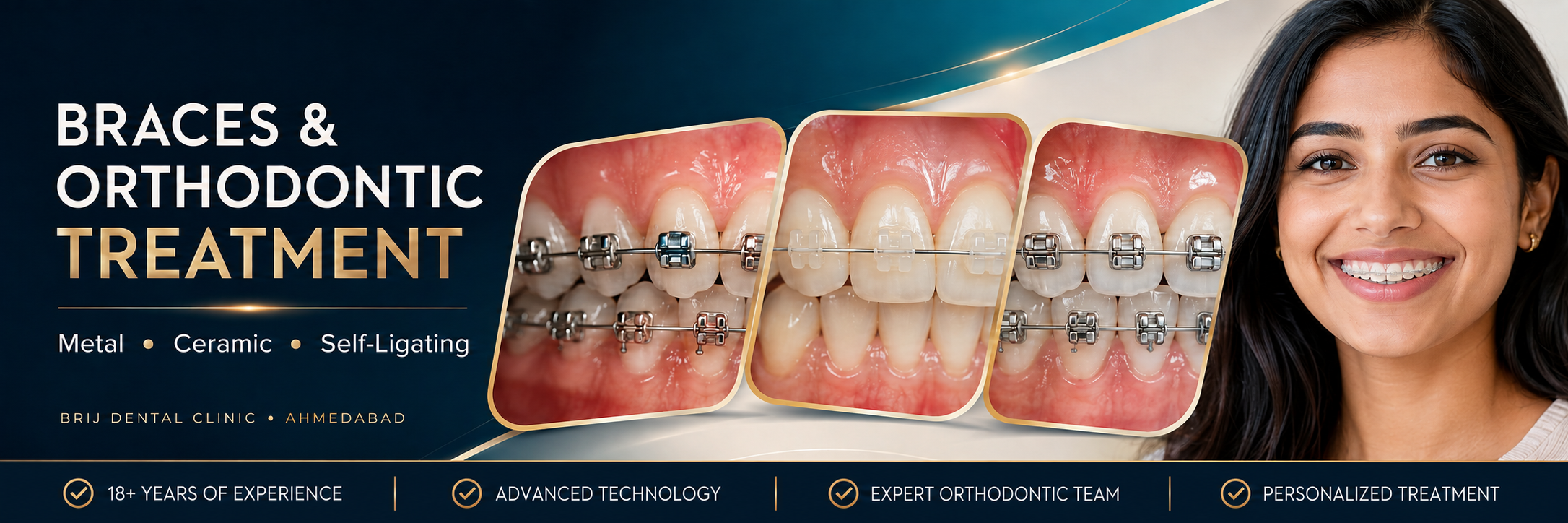
Factors That Influence the Cost of Braces in Ahmedabad

The cost of braces treatment in Ahmedabad varies from patient to patient. An accurate estimate can be provided after a clinical examination and treatment planning.

The main factors that influence orthodontic treatment fees include:

1. Type of Braces

The choice of orthodontic appliance affects the overall treatment cost. Options may include:

  • Traditional metal braces.
  • Ceramic braces.
  • Self-ligating metal braces.
  • Self-ligating ceramic braces.
  • Clear aligners.

The price depends on the appliance system, materials, laboratory requirements, and treatment plan.

2. Complexity of the Orthodontic Case

The complexity of tooth movement and bite correction can influence treatment duration, clinical requirements, and cost.

Examples of potentially complex cases include:

  • Severe dental crowding.
  • Impacted teeth.
  • Significant spacing.
  • Crossbite.
  • Open bite.
  • Class II or Class III malocclusion.
  • Multiple missing teeth.
  • Cases requiring coordinated orthodontic and other dental treatment.

The suitability of each approach must be determined through clinical assessment.

3. Experience and Expertise of the Treating Team

Orthodontic treatment requires careful diagnosis, treatment planning, appliance management, and monitoring.

At Brij Dental Clinic & Implant Center, patients receive treatment planning and clinical care from Dr. Brijesh S Patel and the Team of best orthodontist in ahmedabad. The specific treating clinician’s qualifications, orthodontic experience, and role in your case can be discussed during consultation.

4. Additional Dental Procedures

Some patients may require additional treatment before or during orthodontic care, such as:

  • Interproximal reduction (IPR).
  • Tooth extraction, when clinically indicated.
  • Dental fillings.
  • Professional scaling and oral hygiene treatment.
  • Management of gum problems.
  • Additional diagnostic records.
  • Retainers after braces treatment.

These procedures may involve separate charges depending on the treatment plan.

5. Retainers and Post-Treatment Care

Retainers are an important part of maintaining tooth alignment after active orthodontic treatment.

The type of retainer, number of appliances, replacement requirements, and follow-up schedule may affect the overall cost.

Contact Brij Dental Clinic for a personalized braces treatment cost estimate in Ahmedabad.

Five Stages Of An Orthodontic Treatment At Brij Dental Clinic, Ahmedabad India

  • Stage 1: Orthodontic Consultation and Diagnosis

    The first appointment involves an assessment of your teeth, gums, bite, and overall orthodontic requirements.

    Depending on the case, diagnostic records may include:

    • Clinical dental examination.
    • Intraoral and extraoral photographs.
    • Digital impressions or dental models.
    • OPG (panoramic radiograph).
    • Lateral cephalogram, when indicated.
    • Additional radiographs or records as required.

    The orthodontist will discuss the diagnosis, possible treatment options, expected treatment duration, limitations, risks, and estimated fees.

    The consultation allows patients to understand the proposed treatment plan before proceeding.

    Stage 2: Treatment Planning and Braces Placement

    After the treatment plan is finalized, the braces or other selected orthodontic appliance may be placed.

    For fixed braces, this typically involves:

    1. Preparing the teeth for bracket bonding.
    2. Positioning and bonding brackets.
    3. Placing archwires.
    4. Using appropriate ligatures or bracket mechanisms.
    5. Providing instructions about oral hygiene, diet, and appliance care.

    The procedure is performed according to the planned orthodontic protocol. Mild pressure, tenderness, or discomfort may occur after placement or adjustments and generally varies between patients.

    Stage 3: Regular Orthodontic Adjustments

    Regular follow-up visits are necessary to monitor tooth movement and assess treatment progress.

    During appointments, the orthodontist may:

    • Evaluate tooth movement and bite changes.
    • Adjust or replace archwires.
    • Modify orthodontic components.
    • Check bracket and appliance condition.
    • Address oral hygiene concerns.
    • Review patient comfort and compliance.

    Appointments are scheduled according to the appliance, treatment stage, and clinical requirements. A four-week interval may be used in some treatment plans, but it is not appropriate for every patient.

    Patients should contact the clinic if a bracket breaks, a wire causes persistent irritation, or another appliance problem occurs.

    Stage 4: Braces Removal (Debonding)

    Once the planned active orthodontic treatment is completed, the orthodontist assesses the alignment and bite before removing fixed braces.

    The debonding stage generally includes:

    • Removal of brackets and other fixed components.
    • Cleaning adhesive residue from the teeth.
    • Evaluation of the final tooth positions.
    • Photographs or other records, when indicated.
    • Planning for retention.

    Treatment completion depends on the clinical objectives and the orthodontist’s assessment, rather than simply reaching a predetermined number of months.

    Stage 5: Retainers and Long-Term Maintenance

    Teeth can shift after braces treatment. Retainers help maintain the alignment achieved through orthodontic treatment.

    Depending on the case, retainers may be removable or fixed.

    The orthodontist will explain:

    • Retainer wear instructions.
    • Cleaning and maintenance.
    • Follow-up appointments.
    • What to do if a retainer is lost or damaged.
    • The possibility of long-term or lifelong retention.

    Retention is an important part of maintaining orthodontic results, and adherence to the prescribed retainer plan is essential.

Braces- Orthodontic Treatment Cases Album By Braces Specialist Dr Brijesh S Patel & Team Of Orthodontist

Irregular teeth and Deep bite Treatment Gallery

Irregular Teeth Treatment, Crowding Treatment

Bunny Teeth Correction with Advance Braces

Anterior Cross bite Correction with Selfligating Orthodontic Braces At Brij Dental Clinic, Naranpura, Ahmedabad

Gap teeth treatment with Best Metal Braces in Ahmedabad India

Malocclusion with Canine Teeth Protruding buccaly treated with Extraction Orthodontic Braces Treatement

Before And After Photos Of Braces Treatment AT BRIJ DENTAL CLINIC AHMEDABAD

Copyright @Brij Dental Clinic & Implant Center

Frequently Asked Questions About Orthodontics

WHAT IS ORTHODONTICS?

Orthodontics (also referred to as dentofacial orthopedics) is a specialized form of dentistry focusing on the diagnosis, prevention, and treatment of dental and facial abnormalities.

WHAT IS AN ORTHODONTIST?

An orthodontist is a dental specialist who has received two to three years of additional training and experience. Your orthodontist is able to straighten teeth, correct misaligned jaw structure, and improve the function of your smile.

WHAT’S THE BEST AGE TO VISIT THE ORTHODONTIST?

If you want to improve the look and feel of your smile, then any age can be a great age to see the orthodontist. Average Age is 11 to 13 Years. The American Association of Orthodontists recommends that children first visit an orthodontist around the age of seven; however, orthodontic treatment is not exclusive to children and teens, with about one in every five orthodontic patients being over the age of 21.

WHAT ARE BRACES?

Braces are used by your orthodontist to help you improve the look and feel of your smile. There are several different types of braces to choose from, including:

  • Ceramic braces
  • Traditional metal braces
  • Lingual braces
  • Self-ligating braces
  • Clear braces or Invisible braces

IF I GET BRACES, HOW LONG DO I HAVE TO WEAR THEM?

The amount of time spent in braces will vary depending on the individual patient, because every smile responds differently to treatment. Treatment times can take anywhere between12 to 30 months, but most standard treatments take about 18 months.

DO BRACES HURT?

Braces do not often hurt though you may feel a small amount of discomfort for a couple days as your teeth, gums, cheeks, and mouth get used to your new braces.

IF I HAVE BRACES, DO I STILL NEED DENTAL CHECKUPS EVERY MONTH?

Yes! In fact, it’s even more important that patients receiving orthodontic treatment visit their dentist regularly every month.

CAN I WEAR BRACES EVEN THOUGH I HAVE CROWNS AND MISSING TEETH?

Yes. A tooth with a crown will move just like a tooth with a simple filling. When teeth are missing, orthodontic treatment will aid in the alignment of the remaining teeth.

HOW MUCH WILL MY ORTHODONTIC TREATMENT COST?

Cost of Braces depend upon type of treatment with different type of Braces, complexity of the case and Expertise of Orthodontist Braces Specialist.

Cost of Orthodontic Treatment (Regular Beggs Metal Braces) ( Metal Straight wire), (3M branded Braces) ( Self Ligating Braces American Ortho or Demon) upto (Ceramic Self ligating Braces) depending upon quality and type of braces selected, complexity of treatment and time required for the treatment.

WHAT WILL I LEARN FROM THE INITIAL EXAMINATION?

There are five essential questions that we will cover during the initial examination:

  • Is there an orthodontic problem, and if so, what is it?
  • What must be done to correct the problem?
  • Will any teeth need to be removed?
  • How long will the treatment take to complete?
  • How much will the treatment cost?

WILL MY BRACES INTERFERE WITH MY SCHOOL ACTIVITIES LIKE SPORTS, PLAYING AN INSTRUMENT, OR SINGING?

Playing an instrument or a contact sport may require some adjustment when you first get your braces, but wearing braces will not stop you from participating in any of your school activities. If you play a contact sport, it is recommended that you wear a mouthguard to protect your braces or appliance.

Care With Braces

HOW CAN I TAKE CARE OF MY TEETH IF I’M WEARING BRACES OR A RETAINER?
  • ALWAYS remember to brush your teeth after every meal and floss at least once a day.
  • Make sure to use toothpaste that contains fluoride, and ask your orthodontist or family dentist if you need a fluoride rinse. This will help prevent cavities!
  • If you take out your retainer to eat, make sure you brush your teeth, floss, and remember to keep it safe in its container so that it does not get lost or broken.
  • Keep your retainer clean, too, by brushing it gently with a toothbrush and toothpaste. You may also soak it in denture cleaner as instructed by your orthodontist. Do not put your retainer in boiling water or in the dishwasher.
  • During your treatment, try to avoid foods with a lot of sugar, which increases the amount of bacteria that grows in your mouth, causing more plaque and possibly cavities.
  • Avoid sticky and chewy foods (caramel, chewing gum, gummy bears), hard foods (hard candy, nuts, ice cubes), or any foods that could possibly get stuck in your braces (corn on the cob, soft bagels, ribs, taffy, etc.).
  • Be sure to schedule your routine checkups with your family dentist. It is recommended that you continue to visit the dentist every six months.

Life After Braces

Are retainers necessary and how long will I have to wear one?

A retainer is a device worn full or part-time after braces have been removed. The retainer is designed to prevent your teeth from drifting or moving while the bone around your teeth hardens and stabilizes. The longer you wear your retainer, the better your chances that your teeth will not relapse. Retainers provide assurance that your teeth will stay in perfect alignment while your jaw continues to grow or develop. We recommend that retainers are worn a lifetime.

How often do I have to visit Dr Brijesh Patel’s Brij Dental Clinic when I’m wearing a retainer?

During the first year and a half of retention, you will still visit our orthodontic offices periodically. After that period, you no longer need to visit our offices, but it is your responsibility to wear your retainer as Dr Brijesh Patel prescribes.

Where should I store my retainer?

Protect your retainer — store it in its case so that it doesn’t get damaged. If your retainer does become damaged, call for a repair appointment.