If you are experiencing severe toothache or sensitivity, Dr. Brijesh Patel (MDS UNI FIRST) at Brij Dental Clinic & Implant Center offers the highest standard of single sitting root canal treatment in Ahmedabad to relieve your pain immediately and preserve your natural tooth. Centrally located in Naranpura, Dr. Patel specializes in delivering gentle, completely painless root canal procedures in just one visit.
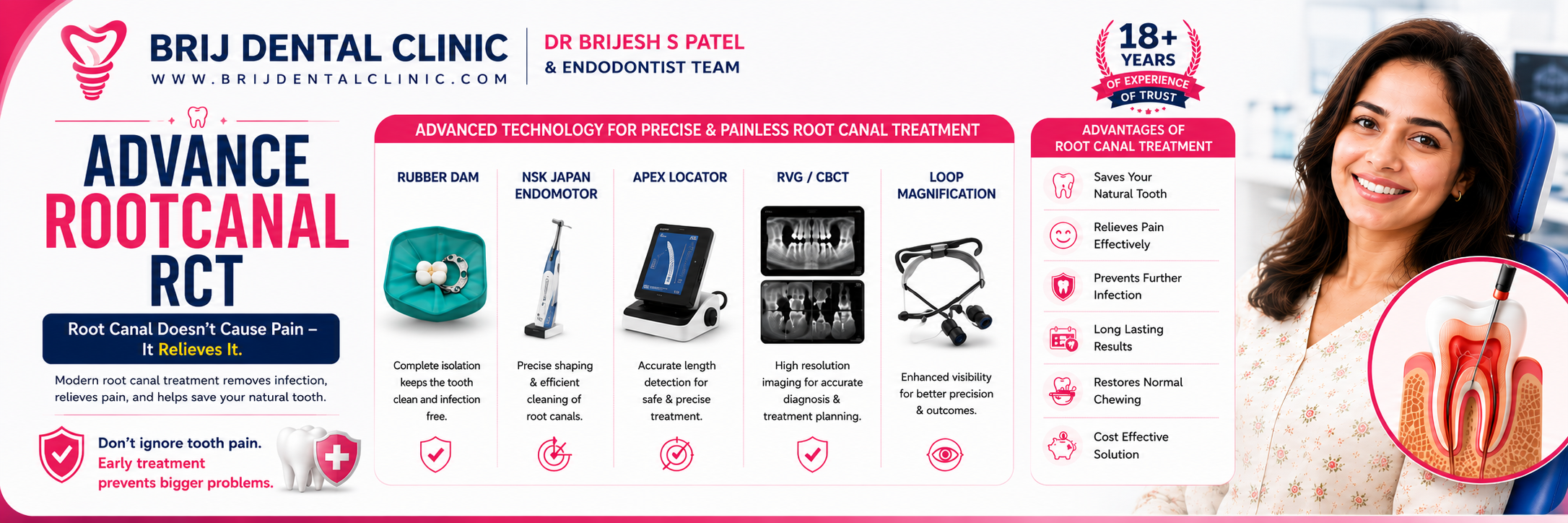
Our clinic provides transparent and competitive root canal treatment prices in Ahmedabad with zero hidden costs, while maintaining international clinical protocols. Every treatment is performed under strict rubber dam isolation using world-class technology, including the Advanced ProTaper Gold System (Dentsply, USA), NeoEndo Flex Files (UK), high-precision NSK Endomotors (Japan), and the Owandy RVG Instant Digital X-Ray System (France) for precise apex verification.
Beyond primary treatments, Dr. Brijesh Patel is an experienced specialist in handling failed root canal treatments (Re-RCT), repeat root canals, broken instrument bypass, and complex complications associated with chronic infected cases. He has undergone advanced clinical training under the renowned pioneer Dr. P. D. Joshi for mastering both primary and complicated repeat root canal procedures.
The cost of root canal treatment (RCT) in Ahmedabad, India, depends on several key clinical, anatomical, and technological factors:
-
Tooth Location & Anatomy: Front teeth (incisors and canines) typically have a single root canal, making the procedure faster and more straightforward. Back teeth (premolars and molars) feature multiple, curved, and complex canals that require specialized rotary instrumentation and additional chairside time.
-
Severity of Infection: A mild pulpitis can be resolved swiftly, whereas a chronic periapical infection with swelling or active pus discharge may require intracanal medicament dressings and extended healing protocols.
-
Endodontic Expertise: Procedures performed by an experienced root canal specialist and endodontist like Dr. Brijesh S. Patel (MDS UNI FIRST) ensure significantly higher long-term success rates, especially for anatomical variations and calcified canals, compared to standard treatment by a general dentist.
-
Single Sitting vs. Multiple Visits: A single sitting RCT in Ahmedabad utilizes advanced computerized endomotor rotary systems, high-frequency sonic activation, and instant digital radiography (RVG) for rapid, sterile, and pain-free treatment in a single appointment.
-
Quality of Bio-Materials: Brij Dental Clinic exclusively uses premium, globally certified dental materials and sealers from international leaders including 3M (USA), Ivoclar (Germany/Liechtenstein), and Coltene (Switzerland) to ensure biocompatibility and maximum sealing longevity.
-
Clinic Infrastructure & Sterilization: Treatment at a multi-chair specialty center like Brij Dental Clinic & Implant Center—equipped with class-B autoclaves, strict rubber dam isolation protocols, and instant digital imaging—provides clinical safety and cross-infection control that exceed basic dental setups.
Taking these factors into account, the final investment depends on whether the tooth is a primary case or involves higher complexity (such as severe curvatures, extra canals, calcifications, or retrieval of broken instruments).
Transparent Root Canal Treatment Price at Brij Dental Clinic Ahmedabad
We believe in complete financial clarity with zero hidden charges. Below is our transparent fee schedule for root canal therapy in Ahmedabad:
| Treatment Type |
Clinical Details |
Price Range (INR) |
| Conventional Root Canal Treatment (RCT) |
Primary treatment (simple to complex multi-rooted teeth) |
₹3,500 – ₹5,500 |
| Advanced Single Sitting Protocol |
Computerized rotary instrumentation with advanced Bioceramic Sealer |
₹6,500* onwards |
| Re-RCT / Failed Root Canal Re-treatment |
Removal of old gutta-percha, bypassing ledges/separated files, resolving chronic periapical lesions |
Evaluated per case based on complexity & sittings |
If you are experiencing persistent tooth discomfort, the inner pulp tissue—containing blood vessels and sensitive nerve fibers—is likely inflamed or infected. While each patient’s symptoms vary based on the extent of pulpal damage, the most common warning signs include:
-
Persistent, Spontaneous Toothache: Throbbing tooth pain that flares up unexpectedly, often intensifying while lying down or at night.
-
Pain While Biting or Chewing: Sharp discomfort or tenderness whenever pressure is applied to the tooth.
-
Prolonged Temperature Sensitivity: Lingering pain or sensitivity to hot liquids (tea, coffee) or cold items that persists long after the stimulus is removed.
-
Swollen or Tender Gums: Localized facial swelling, gum inflammation, or a small boil/pimple (fistula) draining pus near the root tip.
-
Tooth Discoloration: A dark yellow, greyish, or black hue indicating internal nerve necrosis (dead pulp tissue).
You can seek immediate dental care if you have any the following symptoms: Spontaneous pain of the tooth or pain in response to hot stimulus that does not subside. This can be present with or without a swelling in relation to the affected tooth/teeth. Discoloration of teeth or fractured teeth Our teeth have their own circulation and nerves. The veins and nerves running inside the teeth can be damaged by various factors (such as deep decay or trauma).
Here is a step-by-step guide to how the procedure saves your tooth:
- 1. ROOT CANAL OPENING – Following painless injection using SEPTODONT system of anesthesia Your dentist Dr Brijesh S Patel makes an small opening through the top of the tooth down to the pulp chamber.
- Conscious sedation facility in which Laughing gas is passed through mask for anxious patients.
- We have COLTENE brand Rubber dam from Switzerland system for isolation of tooth.
- Excellent Infection Control.
- Increased Patient Safety.
- 2. CLEANING OR BMP OF ROOT CANAL The injured or dead pulp is taken out and the root canals are irrigated and medicated. If Tooth is cleaned and all infection is removed your dentist Dr Brijesh S Patel will complete the RCT in Single Sitting. If Tooth had chronic infection then Two Visit RCT is advised.
- Magnification Loupes which generates high contrast stereoscopic image with good color fidelity extending to peripheral zones to assure accuracy while giving diagnosis and for doing precision work.
- Using Apex locator from J MORITA JAPAN we make sure of the apical constriction and determine the length of the root canal space.
- 3. A temporary filling is placed in the opening at the top of the tooth in order to protect it between procedures.
- 4. ROOT CANAL FILLING (RCF) The temporary filling gets removed and the pulp chamber and root canal(s) are cleaned then filled with Guttapercha and checked in Xray.
- We use EndoActivator Irrigation system for cleaning of canals. These include facilitated access to the entry holes of the root canal systems, filling and shaping canals, cleaning, and reducing the rates of endodontic surgeries and obstruction of intracanal materials.
- 5. A crown or Onlay is placed over the tooth.
When is a re-treat root canal treatment required?
With proper dental care and cleaning routine, a root canal treated teeth last a lifetime. But in some instances, the treated tooth may not heal properly, causing pain or discomfort. Reason for RCT treated tooth may not heal or develop a new problem due to various reasons:
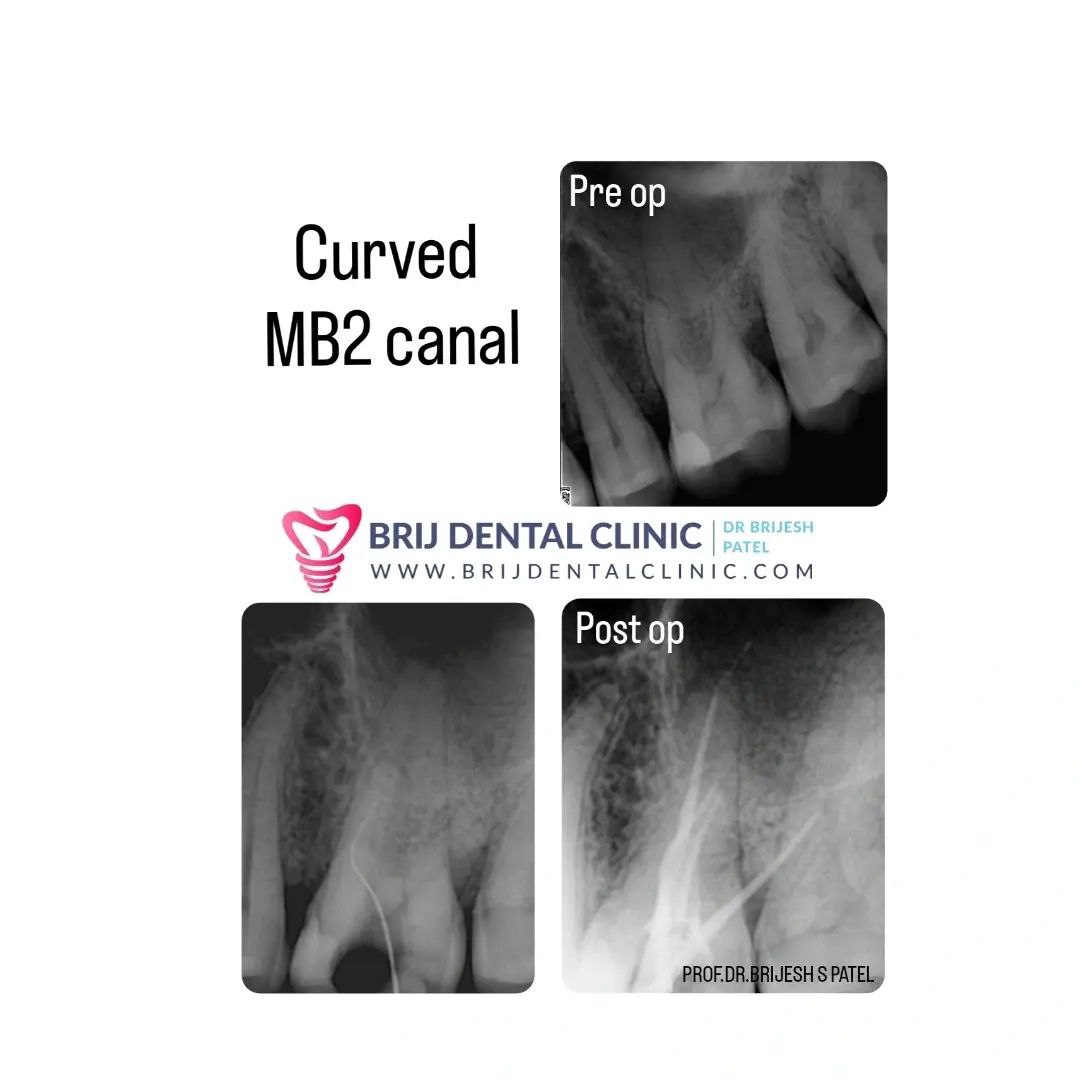
- Narrow or curved canals was not treated by First Dentist
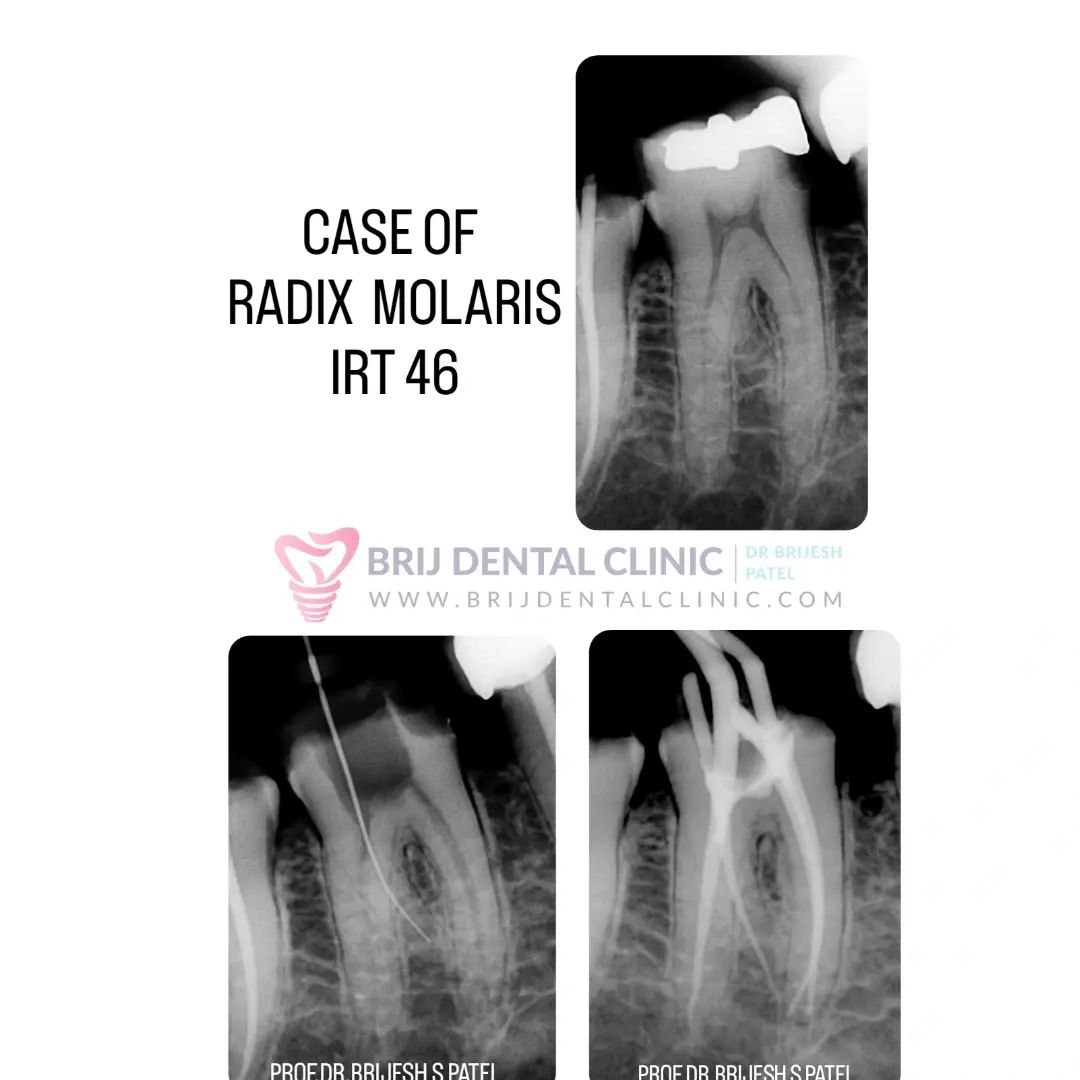
- Complicated canal anatomy
- Delayed placement of the crown or other restoration
- Salivary contamination to the inside of the tooth
- Exposure to bacteria causing a new infection in the tooth
- A loose or broken crown or filling exposing the tooth to infection
Any of these issues can create a new problem and jeopardize a tooth that was successfully treated. This can occur within a few months or even years after the initial root canal treatment. If any pain or discomfort is experienced in a previously treated tooth, immediately talk to your Root canal Specialist Dentist at Brij Dental Clinic, naranpura, Ahmedabad to look into retreatment option.
What is done during re-treat root canal procedure?
The procedure is almost similar to a root canal treatment with difference below,
- Advance RETREATMENT INSTRUMENTS FROM DENTSPLY USA OR NEOENDO UK used.
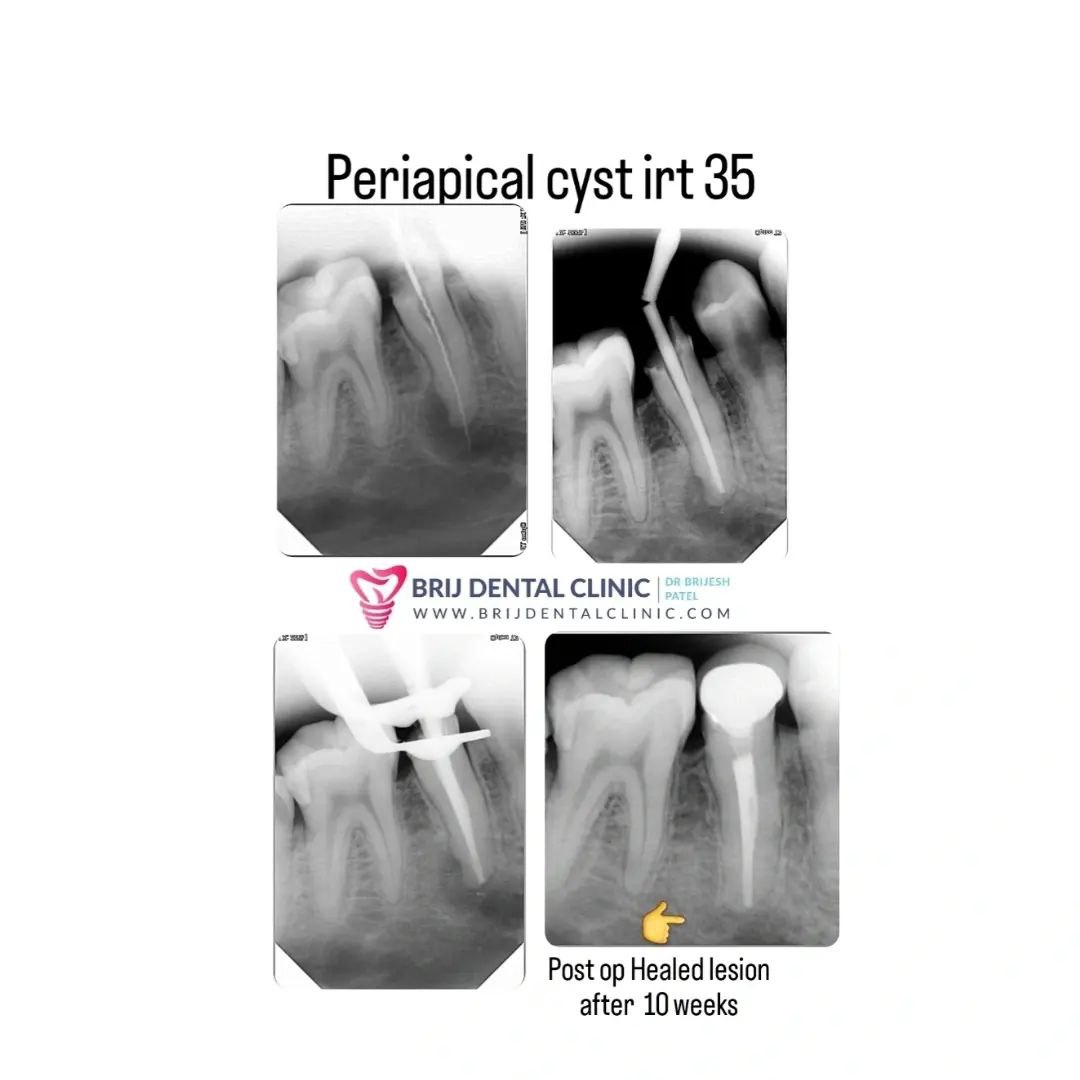
- Repeated MetaPex Corea Dressing given to heal chronic Periapical lesion (Repeated Every 15 days)
- More appointment time, Special expertise, More cost compared to RCT.
If present, the infected area is removed, cleaned and shaped, and new filling material is placed to fill in the gap and sealed. A Crown is placed to protect the tooth against fractures.
What Are the Potential Side Effects of Root Canal Treatment?
Returned infection is a possible, although uncommon side effect of root canal treatment. This can be the result of incorrectly cleaned root canals or an undetected crack in the root of a tooth. That is Why Root Canal has to be done by specialist MDS e.g. Dr Brijesh S Patel
What is root canal treatment (RCT) or endodontic treatment?
Root canal treatment (RCT) or endodontic treatment is the treatment related to the tooth pulp. Root canal treatment is the removal the infected pulp, cleaning and shaping the root canals with tiny needle-shaped instruments and disinfecting solutions, and sealing off the disinfected canals with an inert filling. This relieves pain (and swelling) from toothache and dental abscess.
Is root canal treatment painful?
When you heard of root canal treatment and you just got thinking about the pain. But keep in mind due to high skill, knowledge and latest technologies now era of root canal treatment is different. You only even don’t feel pain when Dr. Brijesh S. Patel’s Endodontist Team give you an anesthesia. Even nowadays you can eliminate this small pain, thanks to “Laser Root Canal Treatment”. But laser root canal treatment is costly than the conventional one.
What are the causes that lead to the tooth pulp(nerves) to die or infected that requires root canal treatment?
Causes for tooth pulp to die or infected are: • Severely or grossly decayed tooth • Direct trauma to the tooth • Deeply restored tooth with tooth filling materials • Crack in the tooth or Cracked Tooth Syndrome • Infected gums or periodontium • Attrition or abrasion of the tooth • Acid erosion
What are the symptoms of died or infected tooth pulp?
There is no symptom present in died tooth pulp because the nerves in the pulp are already necrosed and are not going to give any stimuli. But infected tooth pulp gives the symptoms due to living nerve tissues insides. They are: • Pain on having cold or hot. This pain can be from mild to severe. • Pain on chewing the food. This pain can also be from mild to severe.
What are the diagnostic aids require for root canal treatment?
Dr. Brijesh S. Patel’s Endodontist Team at Brij Dental Clinic, will take an IOPA (Intra-oral Peri-apical) radiograph, which is mandatory to see the condition of one or two teeth. To evaluate multiple infected teeth OPG (Orthopantomogram) may require. Apicectomy may require latest diagnostic aid in dentistry that is CBCT (Cone Beam Computed Tomography).
Who can best treat the case of root canal treatment in Ahmedabad?
There are many branches in dentistry and one of them is Endodontics. Endodontics is the branch of dentistry which deals with diagnosis, treatment, and prevention of the problems related to the tooth pulp. Dentist having the master in this field is known as Endodontist. The endodontist is the person who can best handle the root canal treatment cases. Dr. Brijesh S. Patel’s Endodontist Team at Brij Dental Clinic are the best in ahmedabad for Painless single sitting Root canal or RCT.
What are the chemical, medicaments and filling materials used in the root canal treatment (RCT)?
We Dr. Brijesh S. Patel’s Endodontist Team at Brij Dental Clinic, ahmedabad uses latest advanced instruments and Rootcanal components certified by ADA and IDA only. We uses Following international standard materials only which are certified by USFDA and CE. • Calcium Hydroxide(Meta Corea ) • Chlorhexidine Digluconate gel (Ultradent USA) • Advanced Rotary files (Micromega France) • Gutta-percha (Dentsply USA ) • Core build up ( Para core by Coltene Switzerland)
Root canal treated tooth requires cap (crown) over it or not?
Requiring cap or crown over RC treated tooth depends upon various factors such as, how much tooth loss is there? Are the biting forces are more on RC treated tooth? How much is sound tooth structure left after root canal treatment? But it is advisable to have a crown or Onlay over the root canal treated tooth to save the tooth for a longer time.
What is core build up in root canal treatment and why core build up is necessary?
In some cases, where the natural tooth portion (crown portion) is almost gone may requires some support to hold the tooth filling material. This support can be provided by core build up.
I don’t want to go for root canal treatment then what are the other options?
If you don’t want to go for RCT then you are left with only one choice that is tooth extraction or tooth removal. After tooth extraction you have two choices left, you can go for either Tooth Bridge or Dental Bridge with some modification or trimming to the adjacent natural teeth or you can go for Tooth Implants or Dental Implants.
I don’t want to go for Crown after root canal treatment then what are the other options?
After Root canal you can do Onlay (ceramic onlay or composite onlay) instead crown to restore the tooth. Advantage of onlay is minimum tooth reduction on occlusal surface only, while in case of crown it required reduction of 2mm in all 5 sides.
What is the success rate of the RCT?
If root canal treatment is performed well then the success rate is from 90% to 95% depending on the cases. Some failed conventional root canal treatment can retreat with surgical root canal treatment that is Apicoectomy. Well maintained oral hygiene, proper follow-up and regular six-month dental check-up show good prognosis.
How does the dentist insert the post and core?
Dr. Brijesh S. Patel’s Endodontist Team will remove some of this plastic material making sure to leave the last two to three millimeters to seal the end of the root. This space is now filled by Glass Fiber advanced post to anchor within the root of the tooth. Although posts are usually recommended when there is minimal support for a crown, they are not always necessary. The use of a post will be determined on an individual basis based upon support and structural requirements.